WHAT DOGS
REALLY NEED

IS THE DOG A TRUE PACK ANIMAL?
| WATER, FOOD & SHELTER | ||||
| Clean drinking water, a high quality, nutritious diet and shelter from the elements are fundamental needs and essential to the dog’s overall health and well-being. | ||||
COMPANIONSHIP |
||||
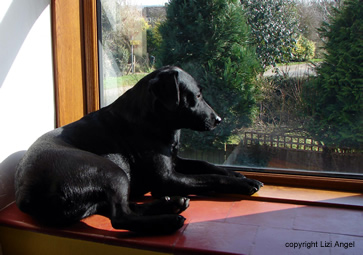 |
Like us, dogs are social creatures.
They need to spend the majority of their time in the company of
others, whether of their own kind or of different species. Many of the dogs that I am called in to work with spend far too many hours of their daily lives in lonely isolation. If you have to regularly leave your dog alone for more than four hours per day, consider employing a dog-sitter or dog-walker, or ask a family member, neighbour or friend if they are able to spend some time with the dog while you are apart. If you are considering getting a dog, please ensure that you either have the time to provide it with company for most of the day, or the means or money to employ someone else to keep it company. |
|||
RULES |
||||
| Rules let the dog know what it mustn't do. Rules set behavioural limits and social boundaries. Rules are established through discipline, body language and daily rituals such as greetings and mealtimes. Rules constitute the dominant-subordinate dimension of the human-canine bond. |
||||
LEADERSHIP |
||||
|
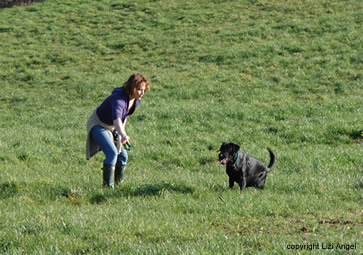
The vast majority of dogs are natural
born followers. Followers need leadership. |
 |
||
Many people associate the concept
of leadership with dominance or social status, however it is neither
of these things. What leadership is, is a person's ability to successfully
direct and manage a dog (or dogs) for the mutual benefit of both
parties. This requires appreciating and accepting a dog's individual
temperament and needs, recognising what a dog is good at and setting
it up for success, knowing how to get the best out of a dog by finding
out what motivates it, and getting a dog to want to work for you. |
||||
ATTENTION & AFFECTION |
||||
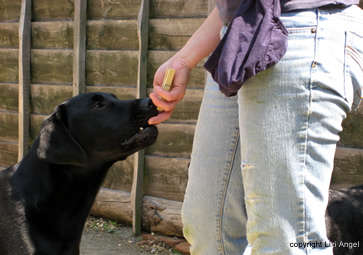
As humans, we often feel that if
we are not fussing and petting our dogs at every opportunity or
buying them new toys each week, we are not giving them enough attention.
However, a dog's idea of attention means being included in daily
activities, being given social boundaries, leadership, regular playful
interaction, and having its basic, physical needs recognised and
catered for. Love is ... companionship, respect, teamwork and
trust, as well as affectionate fuss. |
 |
|||
PHYSICAL EXERCISE |
||||
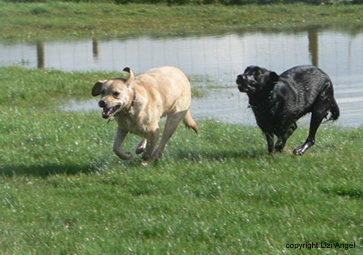
Many behaviour problems can be eased and even solved by increasing or changing a dog’s physical exercise. Scientific studies have shown that long-term, moderate, daily physical exercise causes the body to release beta-endorphins, enhances noradrenergic activity (increasing the production of noradrenaline) and increases serotonin metabolism in the brain. What this means is that over time, moderate, daily physical exercise directly and beneficially affects the dog's brain chemistry, counteracting the adverse effects of stress, enhancing the dog’s general mood, raising tolerance levels, and controlling impulses. Put simply, the right kind of regular, daily physical exercise naturally makes dogs (and humans) feel good. Brisk walking or the 'dog-trot' is the ideal ‘feel-good’ exercise. Walking together is also an ideal opportunity to strengthen the human-canine bond whilst fulfilling the dog’s need to travel and explore. The amount of time per day that many owners spend walking their dogs isn’t sufficient to change or sustain a stressed dog’s brain chemistry for the better ~ a 30-40 minute walk is generally the ideal for a fit and healthy dog's main, daily walk. A brisk walking pace provides near to the ideal level of physical exertion to cause the maximum release of 'feel-good' hormones. A faster pace requires increased physical effort, and if the sustained pace is too fast or hard it doesn't benefit the dog's neuroeconomy, which means that 20 minutes of fast running doesn't produce the long-term, sustainable feel-good factor of 30-40 minutes of dog-trotting. A dog's main form of exercise shouldn't be aimed at tiring the dog out so that it has no energy left to 'misbehave' ~ it should primarily be about changing the dog's mood for the better. |
||||
Whilst brisk walking helps to keep
the dog's mind fit, more demanding forms of exercise such as swimming
and agility
help to keep the dog's body fit. Physical fitness is important to
good health, however, hard or fast exercise does put the dog's body
under varying degrees of physiological stress, and so it's important
that following strenuous activities, a dog has plenty of time to
rest and recover, for example, if a dog spends a couple of hours
racing around an agility course one day (whilst at the same time
having to deal with the intense social environment of an agility
club), the following day should involve lots of rest and just a
couple of short walks. Just bear in mind that the dog's muscles
and joints will almost certainly be aching after a sustained bout
of physically demanding exercise! Some dogs have other ideas and still want to tear about instead of rest, but including some extra psychological exercise such as 20 minutes obedience work, or giving the dog something else to do such as chewing, is usually enough to keep most dogs happy while they take it easy. |
 |
|||
PSYCHOLOGICAL CHALLENGE
|
||||
| Other ways to psychologically challenge your dog and strengthen the human-canine bond include … | ||||
|
||||
All of the above will fulfil most
dogs’ psychological needs without having to employ specialised
training techniques, however, if you want to challenge your dog
further, you could try activities such as heelwork to music, or
search
and retrieve, tracking, working trials, gun-dog training and
search & rescue to utilise his senses and instincts too. |
||||
REST & SLEEP |
||||
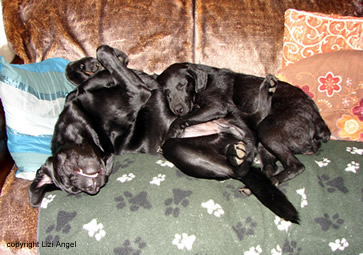
| The average amount of daily rest
(lying down relaxing, dozing and sleeping) that most dogs require
is about 17 hours. Rest and relaxation is important to the management
of biological and emotional stress as it allows the body to recover
from releases of ‘stress’ hormones such as adrenaline
and cortisol. Whilst the release of these and other substances in
response to stress is normal, the levels can build up and become
abnormal if the body is denied sufficient time to rest and recover.
Dogs suffering from long-term stress often display exaggerated behaviour,
and are more prone to aggress because stress lowers emotional and
impulse thresholds ~ in other words, as well as developing compulsive
behaviour, stressed dogs are more likely to overreact in certain
situations, react with less and less provocation each time, or react
impulsively. |
 |
|||
It is so important to provide a
dog with its own comfortable, resting place in a quiet area of the
house where it can go and relax and not be disturbed, during the
daytime and at night. Based on research into human sleep and dream
patterns, I believe it's also important not to wake a dog when it
is in what is known as REM sleep (Rapid Eye Movement), which in
dogs is often characterised by a combination of flickering eyelids,
bodily twitches, yipping, growling and 'sleep running'. Dream-sleep
studies have shown that human subjects repeatedly woken up at the
REM stage commonly experienced feelings of fear and paranoia, and
after only a few nights of dream-sleep disturbance, they become
increasingly ill-tempered and depressed. What follows REM sleep
is a vital, secondary, 'silent' dream-sleep phase that appears to
counteract the effects of the emotions experienced during REM sleep.
So please ... let sleeping dogs lie! |
||||
|
BACK TO TOP |
||||
Copyright
Lizi Angel 2007-2020 |
||||